
The Silent Foundation Destroyer
Mature trees are beautiful, but in North Texas, they are in a constant war with your home for water. A large oak tree can consume over 100 gallons of water per day. During our brutal summer droughts, when surface water evaporates, tree roots will aggressively tunnel directly beneath your foundation to suck the trapped moisture from the clay soil.
This creates localized desiccation. The soil beneath one corner of your house shrinks rapidly, creating a massive void. The heavy concrete slab, now unsupported, crashes downward, pulling your brick walls and drywall with it.
Stop the Damage Before Summer
Tree roots grow rapidly toward water sources. If you notice a massive tree within 20 feet of your foundation, the roots are already beneath your home. Don't wait for the foundation to crack. A root barrier is a proactive shield that saves you thousands in structural repair.
"We had a massive live oak right next to our master bedroom. A+ Foundation Repair installed a 40-foot barrier system. They saved our favorite tree and totally stopped the foundation from sinking further!"
The Permanent Root Barrier Solution
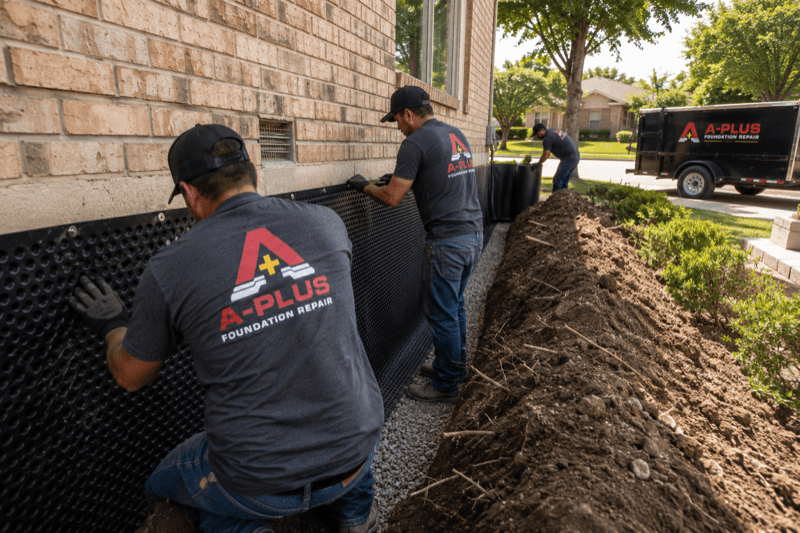
A+ Foundation Repair installs commercial-grade High-Density Polyethylene (HDPE) panels. We carefully trench 30 to 36 inches deep between the tree and your foundation. Once inserted, these overlapping panels act as a permanent, impenetrable wall. When roots hit the barrier, they are forced to grow safely downward and away, completely bypassing the soil that supports your home.
Signs Tree Roots Are Attacking Your Foundation:
- A large tree is located within 20 feet of your house
- Foundation settlement occurring exclusively nearest the tree
- Tree roots surfacing in your yard or pushing up walkways
- Sticking doors in the rooms closest to the tree
- Plumbing backups (roots actively seeking water inside pipes)
Protecting Your Property Value
Mature trees add immense curb appeal and value to your home. But if those same trees are cracking your brick and drywall, that value plummets. By utilizing A+ Foundation Repair to install an engineered root barrier, you get the best of both worlds: you preserve the beautiful landscaping that increases your property value, while guaranteeing the structural integrity of your foundation.
Protect Your Slab
Roots never stop growing. Get a free assessment to see if your trees are threatening your foundation today.
Schedule Free EvaluationOr call (972) 436-2595Why Choose A+
- Thick HDPE Barriers
- Fully Licensed & Insured
- Family Owned & Operated
- Decades of DFW Experience
Root Barrier Installation: Frequently Asked Questions
Straight answers about root barrier installation — method, cost drivers, timelines, and what to expect afterward.
How do tree roots damage a foundation?
A mature tree draws a very large volume of water out of the soil each day. During a dry summer its roots extend toward whatever moisture remains, which is often the soil under your slab. As those roots pull water out, the clay contracts and that section of the foundation loses support and drops, producing settlement in one localized area.
Do I have to remove my tree?
Usually not, and that is the point of a barrier. A root barrier redirects root growth downward and away from the foundation so you keep the tree, the shade, and the curb appeal without the structural risk. Removal is a last resort we recommend only when a tree is too close and already causing active damage.
How close is too close for a tree to a foundation?
A useful rule of thumb is that a tree should be at least as far from the house as its mature canopy is wide, and large species such as live oaks and elms need considerably more room. Trees planted closer than that are not automatically a problem, but they are the ones most worth protecting against with a barrier.
How deep does a root barrier need to be?
Deep enough to intercept the roots that matter, which typically means several feet. A shallow barrier simply gets grown under. We set the depth based on the species, the size of the tree, and the soil profile at your property.
What are root barriers made of?
We install high-density polyethylene barriers, which are impermeable, durable, and do not degrade in soil the way lesser materials do. They are trenched in vertically between the tree and the structure to form a continuous vertical wall.
Will installing a barrier hurt my tree?
Properly installed, no. A barrier trenched on one side redirects growth rather than severing the root system, and the tree continues drawing water from the remaining directions. Poor installation that cuts too large a share of the root zone can stress a tree, which is exactly why placement and depth are decided deliberately.
How much does root barrier installation cost?
Cost is driven by the length of barrier required and the trenching depth. It is one of the least expensive preventive measures available relative to what a localized settlement repair costs, which is why we often recommend it alongside piering.
How long does installation take?
Most root barrier installations are completed in one day. We trench, set the barrier, backfill, and restore the surface.
Should I install a barrier before or after foundation repair?
If a tree is what caused the settlement, the barrier should go in as part of the repair. Piering the affected area without addressing the root cause leaves the same tree pulling moisture from the same soil, and the surrounding structure stays at risk.
Can a root barrier reverse damage that already happened?
No. A barrier is preventive: it stops the mechanism from continuing. Elevation already lost has to be recovered through piering or leveling. The two work together, with the barrier protecting the repair you just paid for.
Trusted Across North Texas
See why your neighbors rely on A+ Foundation Repair.
Trusted by Homeowners
Don't just take our word for it. See what our clients are saying.
Texas Weather Changes Fast. Don't Wait.
Foundation damage doesn't fix itself—it only gets more expensive. Protect your home's value before the next heavy rain cycle shifts your soil. Get a completely free, no-pressure structural evaluation today.